
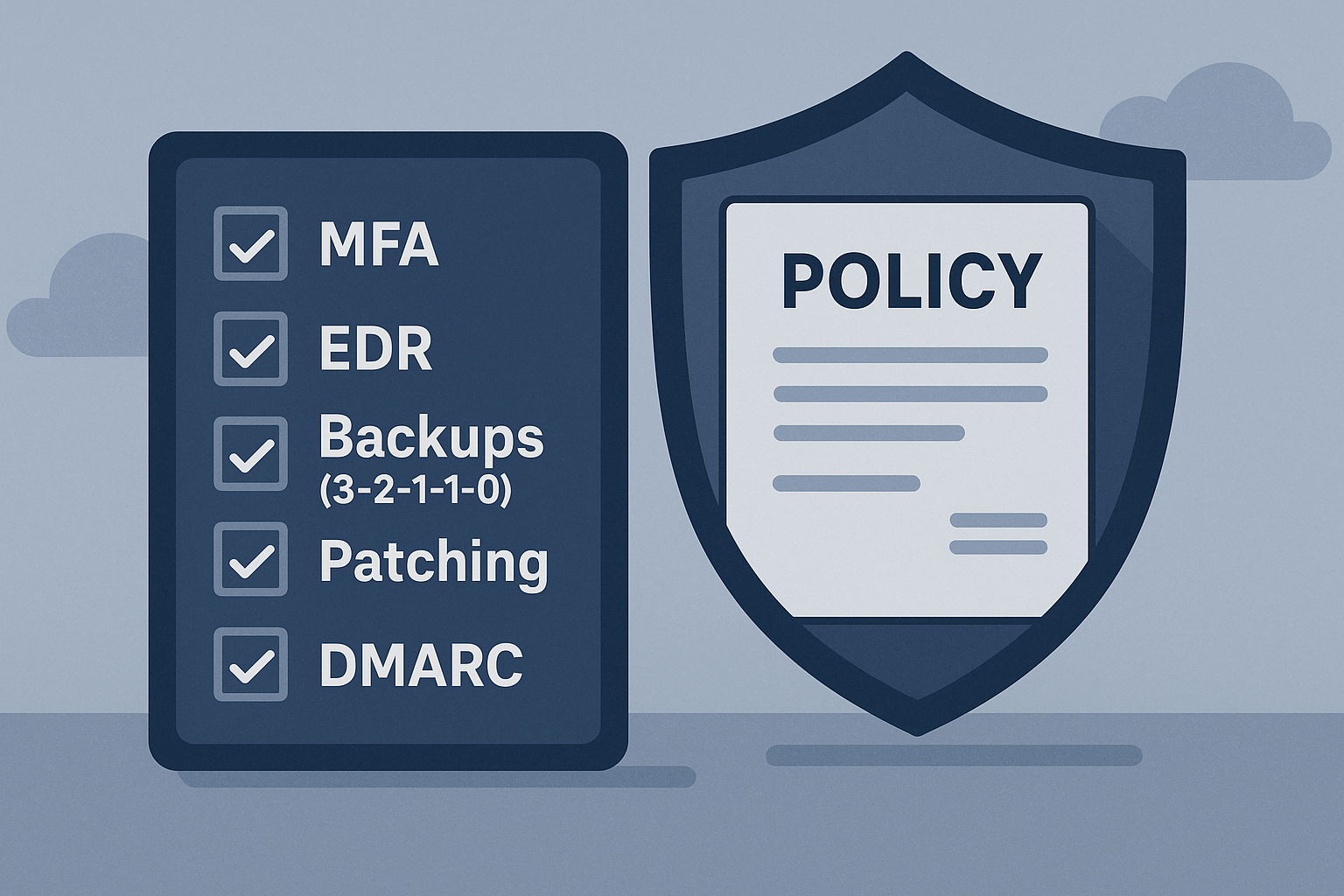
Cyber insurance has grown up. In 2025, insurers aren’t just asking yes/no questions and sending a quote, they expect evidence that your business is managing risk. If you can’t show the basics are in place, you’ll pay more, face exclusions, or get declined altogether.
The upside? The controls insurers want are the same ones that actually reduce incidents. Put them in place and you’ll lower risk and premiums.
🧾 What’s Changed Since Last Year
Stricter questionnaires: More detail, fewer grey areas, audits on renewal.
Minimum controls: No MFA, no cover. Weak backups, higher excess.
Claims scrutiny: Payouts depend on proof (logs, backups, response steps).
Sector sensitivities: Finance, legal, healthcare, and ecommerce see closer checks.
✅ The Baseline Controls Most Insurers Expect
1) MultiFactor Authentication (MFA) everywhere
Admin accounts, email, VPN, remote access, and key SaaS apps. Use number matching or passkeys where possible.
2) Endpoint protection with EDR
Modern antivirus plus Endpoint Detection & Response on all devices, including laptops used from home.
3) Backups that follow the 32110 rule
Three copies, two media, one offsite, one immutable, zero errors in recovery tests. Prove you test restores regularly.
4) Patch & vulnerability management
Routine updates for OS, browsers, and apps. Critical patches within days; legacy systems isolated.
5) Email & identity protections
SPF/DKIM/DMARC enforced, conditional access, least privilege, and disable legacy authentication.
6) Incident response plan
Document who does what, how to contain, who to notify, and how to engage forensics/legal/insurer. Practice it.
7) Supplier & data controls
Due diligence for key vendors; encryption for sensitive data at rest and in transit.
💬 How to Talk to Your Insurer (and Get a Better Outcome)
- Answer accurately, don’t over promise. If a control is “in progress,” say when it will be done.
- Provide proof: screenshots, policy docs, backup test logs, MFA reports, EDR coverage.
- Show cadence: monthly patching, quarterly restoration tests, annual incident drills.
- Ask for guidance: brokers can tell you which gaps will most affect premium and cover.
💸 What Affects Price (Beyond Controls)
- Claims history & industry risk
- Data sensitivity & transaction volumes
- Remote work exposure (personal devices, unmanaged access)
- Response maturity (playbooks, tooling, partner support)
🚀 A Simple Roadmap to Get Insurable (and Stay That Way)
Week 1–2: Quick gap assessment: MFA, backups, EDR, patching, email auth.
Week 3–4: Close high impact gaps; document policies; enable conditional access.
Month 2: Test restores, run a tabletop exercise, switch DMARC to quarantine.
Ongoing: Monthly patching, quarterly recovery tests, annual review with broker & IT partner.
🧭 Bottom Line
Cyber insurance isn’t a silver bullet, it’s your financial safety net. Insurers in 2025 want proof that you’re doing the basics well. Put those fundamentals in place and you’ll reduce risk, strengthen your security posture, and get better value from your policy.
Need help getting “brokerready”? We can review your controls, fix gaps, and package the evidence your insurer expects; without the jargon.
👉 Contact Us to get started.